Taiwan’s economy has achieved an extraordinary benchmark in 2025: its GDP per capita has risen above both South Korea and Japan, ranking fourth in Asia among all economies, according to the latest International Monetary Fund (IMF) data. This milestone underscores Taiwan’s accelerated growth trajectory driven by booming demand for advanced technology — particularly artificial intelligence (AI)-related semiconductors — and represents a major shift in Asia’s economic landscape.
A New Economic Ranking for Taiwan in Asia
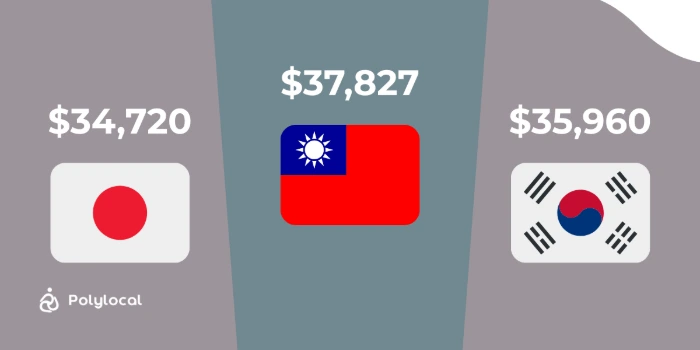
Based on IMF estimates for 2025, Taiwan’s GDP per capita is projected at approximately US $37,827, surpassing South Korea’s US $35,960 and Japan’s US $34,720 this year. In Asia, Taiwan now ranks fourth — trailing only Singapore, Macau, and Hong Kong on this metric of average income and economic output per person.
This achievement is especially notable because it marks the first time in more than two decades that Taiwan has overtaken South Korea in terms of GDP per capita, and it extends Taiwan’s edge over Japan for a second consecutive year.
Economic analysts attribute this breakthrough to Taiwan’s deep integration in the global semiconductor and AI value chain, intensified global demand for high-performance computing components, and strong performance by local technology firms.
Robust Growth Throughout 2025
Taiwan’s surge in GDP per capita didn’t happen in isolation — it’s backed by one of the strongest economic growth performances in Asia this year.
Record High Growth Rates
The Directorate-General of Budget, Accounting and Statistics (DGBAS), Taiwan’s official economic statistics agency, revised the 2025 GDP growth forecast sharply upward to about 7.37 %, the highest annual growth rate in 15 years. This figure surpasses earlier expectations and reflects resurgent economic momentum, particularly in technology exports driven by AI-related demand.
Third-quarter data underscored this acceleration: Taiwan’s GDP expanded by over 8 % year-on-year, led predominantly by an export boom.
Sustained Momentum Into Next Year
While growth is expected to moderate from this year’s peak, institutions like the Taiwan Research Institute forecast continued expansion into 2026, with growth projected around 3.25 % – 3.5 % as the global AI demand remains resilient.
Exports: The Engine of Growth
Taiwan’s export performance in 2025 has been nothing short of remarkable:
- In November 2025, export orders soared by nearly 39.5 % year-on-year, marking the fastest growth in nearly five years and extending a 10-month streak of rising orders — a key indicator of global demand for Taiwanese goods.
- Export orders are expected to top US $700 billion for the full year, potentially setting a new record for Taiwan’s export sector.
- Telecommunications and electronics products recorded strong double-digit increases, with orders from key markets like the United States, Europe, and Japan all rising significantly.
This export surge has been driven primarily by AI and high-performance computing components, sectors where Taiwan plays a central role in global supply chains — especially in semiconductor manufacturing.
Underlying Drivers of Taiwan’s Economic Performance
1. AI and Tech Leadership
Global demand for AI systems — from cloud computing infrastructure to next-generation smart devices — has boosted Taiwanese technology exports and industrial output. Taiwan’s semiconductor ecosystem, led by companies such as Taiwan Semiconductor Manufacturing Company (TSMC), is a core contributor to this export dynamism.
Government initiatives and long-term investments in AI infrastructure and innovation also reinforce this positioning, laying the groundwork for sustained competitiveness.
2. Export Diversification and Global Demand
While technology and semiconductors are at the forefront, Taiwan’s export portfolio also includes telecommunications gear and other electronics, benefiting from strong demand across multiple regions.
3. Policy Support and Growth Forecasts
Domestic forecasts reflect strong confidence in Taiwan’s economic resilience. Several think tanks and official bodies have repeatedly revised growth estimates upward throughout 2025 as global conditions and export performance exceeded expectations.
Broader Economic Context and Challenges
While the headline data — such as GDP per capita and export strength — is impressive, it’s also important to present a full picture:
- Income distribution and wage dynamics: Some indicators suggest that despite strong GDP growth, average wage growth has not kept pace for all sectors, highlighting an ongoing challenge in translating macro gains into broad household income improvements.
- Geopolitical and tariff risks: Global trade policies and tensions — including tariffs on certain Taiwanese exports — continue to inject uncertainty into the economic outlook, though key high-tech products like semiconductors remain exempt from some levies.
Nevertheless, Taiwan’s overall growth performance this year has outpaced many regional peers, reshaping perceptions of its economic maturity and competitive standing.
What This Means for Global Business and Investment
Taiwan’s rise to fourth place in Asia by GDP per capita isn’t just a statistical milestone — it’s a signal to global markets that Taiwan is a hub of innovation, productivity, and export-driven growth. This presents distinct advantages for businesses:
- Strong purchasing power growth: Rising per-person income indicates increasing capacity for consumption of higher-value goods and services.
- Tech ecosystem excellence: A world-class tech supply chain, particularly in semiconductors and electronics, makes Taiwan an attractive partner and supplier for global firms.
- Market access and integration: Taiwan’s export connections span North America, Europe, and Asia, offering diverse channels for business expansion.
For companies seeking strategic footholds in Asia — whether in technology, manufacturing, services, or investment — Taiwan’s economic trajectory makes it an appealing destination for market entry and partnership.
If you’re considering entering or expanding in Taiwan, contact Polylocal to discuss market entry, partnerships, and localization strategies.