Taiwan is one of the most digitally engaged markets in the world, but nowhere is that clearer than on Threads. A market of just 23 million people is generating roughly a fifth of Threads' entire global traffic — a level of engagement no other country comes close to matching. For any European company trying to build visibility in Taiwan, or any Taiwanese brand trying to reach a younger, highly online audience, Threads has quietly become one of the most important channels to understand.
Here's what's actually happening on the platform, and how marketing on Threads differs from what most teams are used to on Facebook or Instagram.
Taiwan's outsized role in Threads' global growth
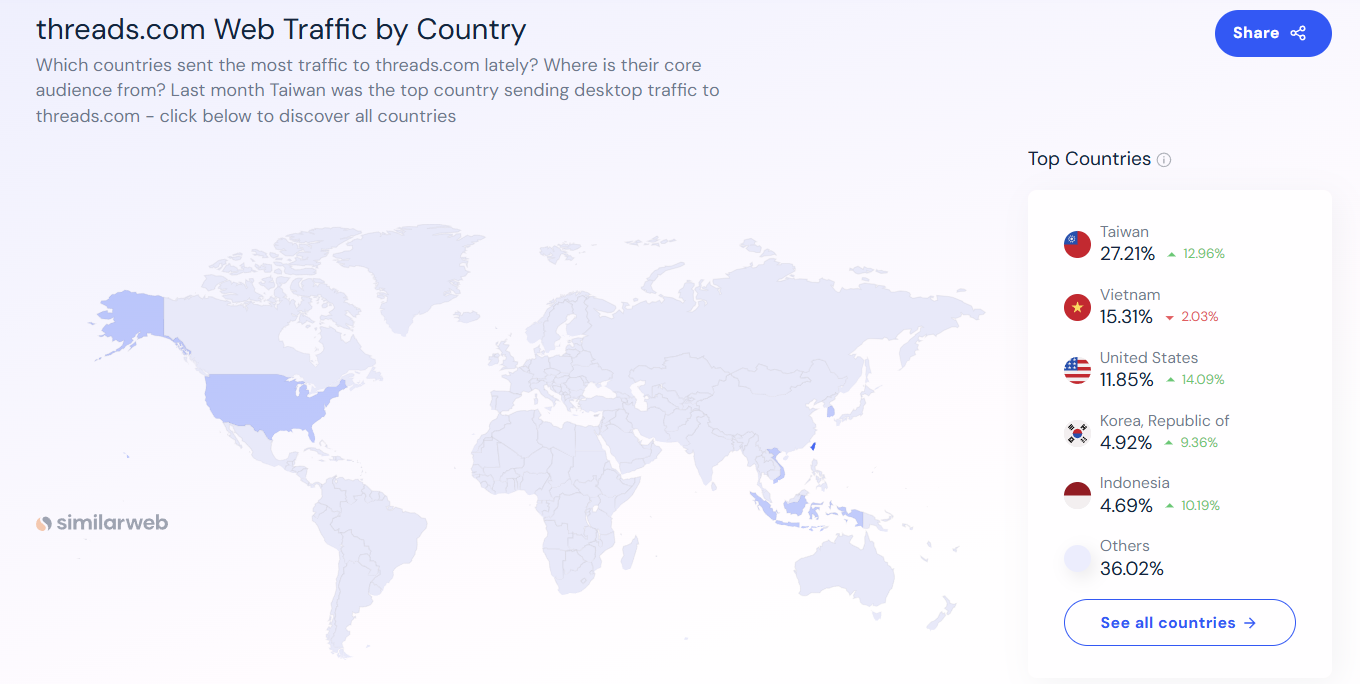
Similarweb's traffic data, cited in Semrush's country-level breakdown, puts Taiwan at around 27% of all global traffic to Threads — more than any other country, including the United States. That share has fluctuated between roughly 18% and 28% over the past year depending on the measurement period, but it has consistently kept Taiwan in first place worldwide. Given Taiwan's population is a fraction the size of markets like the US or India, this is an extraordinary concentration of activity on a per-capita basis.
The user numbers back this up. According to DataReportal's Digital 2026 Taiwan report, which draws on Meta's own advertising data, Threads had roughly 6.65 million users in Taiwan in late 2025 — nearly 29% of the total population and almost a third of the country's internet users. That makes Threads the third most-used social platform in Taiwan, behind only Facebook (around 18.1 million users, still the market leader) and Instagram (around 11.3 million users). Similarweb's own Taiwan social media rankings confirm the picture, placing Threads above established local platforms like PTT and Dcard as of February 2026.
What makes this more than a curiosity for marketers is the growth trajectory. Threads is the fastest-growing of Taiwan's three major platforms, and its content structure — short, text-first posts with a lightweight, low-production-value feel — makes it dramatically easier for a single post to go viral than on Instagram or Facebook, where reach is increasingly pay-to-play. A well-timed post from a small or unknown account can realistically outperform a paid campaign on other platforms, purely on the strength of the algorithm's willingness to distribute new content widely.
The demographics are also favorable for brands: per DataReportal's figures, Taiwan's Threads audience skews 18–34 (about 52% of users), with an almost perfectly even gender split (49.6% female, 48.9% male). This is a younger, more balanced audience than Facebook's, and less saturated with advertisers than Instagram's.
How marketing on Threads is genuinely different
Most brands' instinct is to treat Threads as "Instagram with text" and repurpose existing content. That's a mistake. The platforms reward different behavior entirely.
1. Text carries the weight, not visuals. Threads is fundamentally a text-first, conversational platform, closer in spirit to X (Twitter) or a public group chat than to Instagram's polished, image-led feed. A strong hook in the first line matters more than a strong photo. Brands that succeed here write like a person, not like a marketing department — sharing opinions, observations, behind-the-scenes commentary, or a genuine reaction to something happening in the industry.
2. Reach is not follower-dependent. On Instagram and Facebook, organic reach is largely capped by your existing follower count and the platform's incentive to push you toward paid ads. Threads' algorithm is still comparatively generous to new and small accounts, and it actively surfaces posts from people you don't follow if the content is engaging. This is precisely why "the fastest growing platform" and "easiest to go viral" go hand in hand — the algorithm hasn't yet been tuned to starve organic reach the way Meta's older platforms have.
3. Engagement, not aesthetics, drives distribution. Replies, quote-posts, and reposts matter more than likes. Content that invites a response — a question, a mildly contrarian take, a "does anyone else..." — tends to outperform content that simply announces something. This is a real shift for brands used to optimizing for a clean, static grid.
4. It rewards frequency and personality over polish. Because there's no production overhead, brands that post often, in a consistent voice, tend to compound their reach over time. A single viral post can bring in more relevant followers than months of paid Instagram promotion — but it requires treating Threads as an ongoing conversation rather than a broadcast channel.
5. Taiwan-specific content culture matters. Taiwanese Threads culture leans toward humor, self-deprecation, local news commentary, and community-driven discussion threads (pun intended). Brands entering the market — especially non-Taiwanese ones — get more traction adapting to this tone than importing a corporate voice built for LinkedIn or a polished Instagram aesthetic.
What this means for brands building visibility in Taiwan
For European companies trying to establish a presence in Taiwan, Threads is arguably the most efficient entry point available right now. It's less competitive than Instagram, cheaper to test than paid Facebook campaigns, and structurally biased toward rewarding new voices rather than protecting incumbents. For Taiwanese brands or Taiwan-facing companies targeting a younger domestic audience, it's simply where the attention already is — and where it's still growing fastest.
The catch is that Threads punishes anything that looks like a repurposed Instagram caption. Getting real traction means building a genuine content voice for the platform: conversational, quick, opinionated, and native to how Taiwanese users actually talk online.